
1.
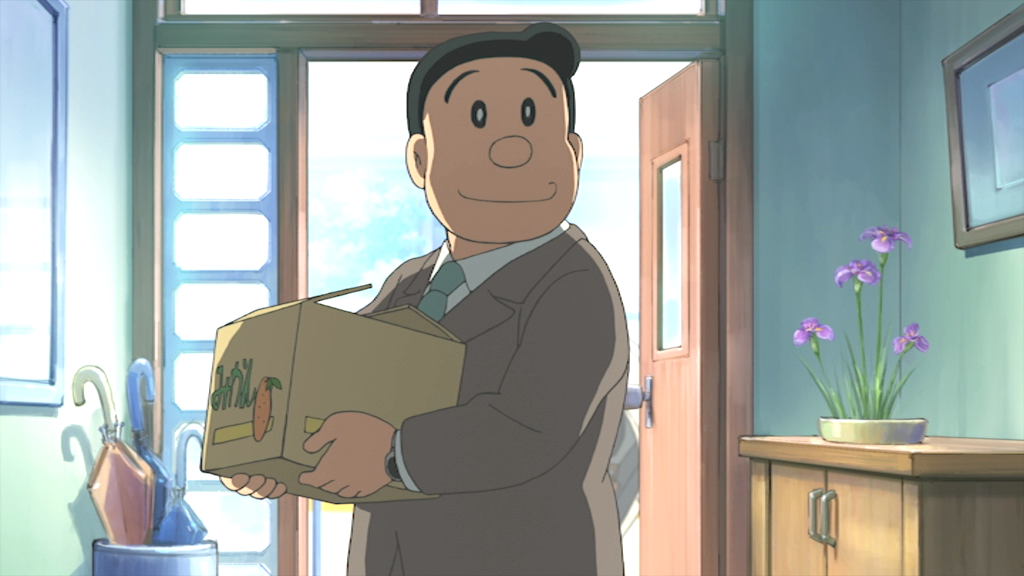
In the Doraemon manga series, author Fujiko F. Fujio once devoted a small portion of the story to the youth of Mr. Nobi – the father of the main character. As a teenager standing on the threshold of adulthood, Nobi was a clumsy and timid boy, yet he always nurtured a deep love for painting. He drew constantly, became the student of a famous artist, and dreamed of becoming a professional painter in the future.
Many years later, that schoolboy Nobi had grown into an adult, pushed and squeezed inside crowded subway trains every day to get to work, returning home only after dark. On weekends, he sometimes had no choice but to miss family picnics because he needed to rush to the office to handle unexpected tasks, or accompany his boss on golfing or fishing trips. Occasionally, he came home late at night, completely drunk. Only then—thanks to his son’s time machine—could Mr. Nobi freely pour out his frustrations to his late mother about his difficult department manager. But the next morning, after sobering up, he returned once again to the same busy, stressful routine.
The memory of his youthful artistic dream now only flickered faintly whenever he met his old teacher, or when he glanced at a painting he had kept since his school days. While his son Nobita and the neighborhood kids were fascinated by wondrous adventures in dinosaur lands and purple planets, somewhere else in reality, there were adults working tirelessly to get through daily life, quietly burying within themselves the dreams they never fulfilled.

2.
I once wondered: Where do forgotten dreams go when people no longer think of them or lose sleep over them?
In a short film I watched long ago, there was a boy who always spent time with his dream. That dream took the shape of a teenager about his age. Every day, the boy went to school, returned home, did homework, and played games together with his dream-friend. His life became more colorful and meaningful because of that companion.
But as he grew older, he took more classes, faced pressure from family and the outside world, and the time spent with his dream grew smaller. One day, his dream no longer had a place inside his home. It stood alone outside the gate, looking in with longing eyes.
If dreams had human form, then the dream of Mr. Nobi—and the dreams of many adults on Earth—must have also stood before a locked gate, quietly watching the person they belonged to, waiting day after day for the sound of an opening lock, only to finally walk away in despair.
If there were a boulevard for broken dreams, it would surely be crowded with all kinds of abandoned dreams, wandering barefoot through the night, walking endlessly until collapsing in exhaustion.
“I walk this empty street
On the Boulevard of Broken Dreams
Where the city sleeps
And I’m the only one, and I walk alone.
My shallow heart’s the only thing that’s beating
Sometimes I wish someone out there will find me.”
(“Boulevard of Broken Dreams” – Green Day)
Every day, every hour, more dreams arrive on that quiet boulevard. And perhaps, when people no longer want to remember their past wishes, those dreams fade and turn into dust.
Isn’t it sad to realize that not every dream becomes reality, and no one can always live the life they once imagined in childhood? Like Mr. Nobi, many people once dreamed beautiful, ambitious dreams, yet very few travel all the way to the end of their dreams.
What happened to those dreams? Nothing tragic—just the natural course of life. Dreams come to us when we are young, making life more exciting, opening countless doors in our imagination. But at certain crossroads, we realize we can no longer carry them with us—for countless reasons: lack of opportunity, lack of ability, lack of perseverance, lack of courage…
So dreams are left behind, like bulky luggage no longer needed.

3.
I used to think the contrast between the dreams and the reality of people like Mr. Nobi was bitter and pitiful, especially when the media constantly pushes messages like “Pursue your passion and success will follow,” or “If you don’t build your own dream, you’ll help someone else build theirs.”
Dreams once burned brightly, while reality is painfully ordinary. I used to measure adult lives that way—until I grew older, stumbled a few more times, and witnessed more stories.
The media can list countless successful figures, but rarely reveals the sadness of those who failed, or the struggles and stress of those who chase passion at all costs.
One day in May, I heard that a girl I knew had given up her dream of studying in the U.S. after five years of effort. She had studied English diligently, joined extracurricular activities, and applied twice. Her story could have become another inspirational headline about Vietnamese students earning scholarships abroad—if not for one final twist:
She did not receive a visa from the embassy, despite having both a scholarship and an admission letter.
People like her will never appear in news headlines. Few would read a story about someone who tried their best but whose luck never arrived.
But life always works that way—not every story has a happy ending.
Yet that is not the end. For those who never reach their dream, they may return to the starting point—but they are no longer the same. They become stronger, wiser, richer in experience. After years of studying, writing essays, and learning languages, she was no longer the timid girl from a small town, but someone ready to seize new opportunities. And perhaps one day, a new door will open for her.
As for people like Mr. Nobi, who choose a life not tied to their childhood dreams, they may not become extraordinary; they may build the dreams of others. But they themselves have become a quiet, essential part of this world.
Whether grand or humble, whether fulfilled or fading into memory—a dream is still a dream. And abandoned dreams do not simply die. They remain—like the paintings Mr. Nobi made of his son since birth, or in the peaceful moment he stands in the yard on a sunny day, holding a paintbrush.
4.
While writing these lines, a scene from You Are the Apple of My Eye suddenly resurfaced in my mind. A group of high school friends sit together on steps near the sea, legs swinging, each taking turns sharing their dreams for the future.
“I want the world to be a little different because I existed,” the main character, Ko Ching-Teng, says after a brief hesitation.
Years later, those children who once looked up at the vast blue sky have all grown up. Not all walked to the end of their youthful ambitions. Yet the moment they stood by the sea and spoke their purest wishes must have become a beautiful memory accompanying them for life.
I am just like those kids by the shore, carrying my own dreams and still feeling confused about them. I cannot tell anyone what they should do with their dreams—just as Nobita, even after traveling back in time to meet his teenage father, still could not change the fact that his father would not become a painter.
There is only one thing I truly believe:
No matter the ending, dreams are a pure gift life grants us.
To have a dream at all is already wonderful—already a small flame lighting our path, warming our hearts, giving our fragile souls the patience to keep walking without losing our way.
Just that alone is enough for a dream to never be meaningless.